Contractors working on drainage systems often face tough decisions about materials, joint performance, longevity, hydraulics, and installation. Among plastic piping options, PE4710 HDPE resin is gaining strong attention because it offers mechanical resilience, chemical resistance, and flexibility that suit drainage and trench systems. Understanding its role in storm drainage applications helps ensure consistent performance and cost efficiency across large-scale infrastructure projects.
PE4710 Resin in the Context of Drainage Applications
PE4710 resin is a high-performance polyethylene formulation engineered for higher strength, improved resistance to slow crack growth, and long service life. It is recognized under ASTM F714 and listed in the Plastics Pipe Institute’s TR-4 documentation, confirming its suitability for demanding infrastructure environments.
Compared with earlier HDPE materials such as PE3408, PE4710 offers about 25% more pressure capacity and superior resistance to crack propagation. These characteristics make it ideal for systems experiencing variable loads from soil settlement, groundwater pressure, or heavy traffic. The enhanced durability also supports sustainable water and drainage infrastructure, where long service life is a priority.
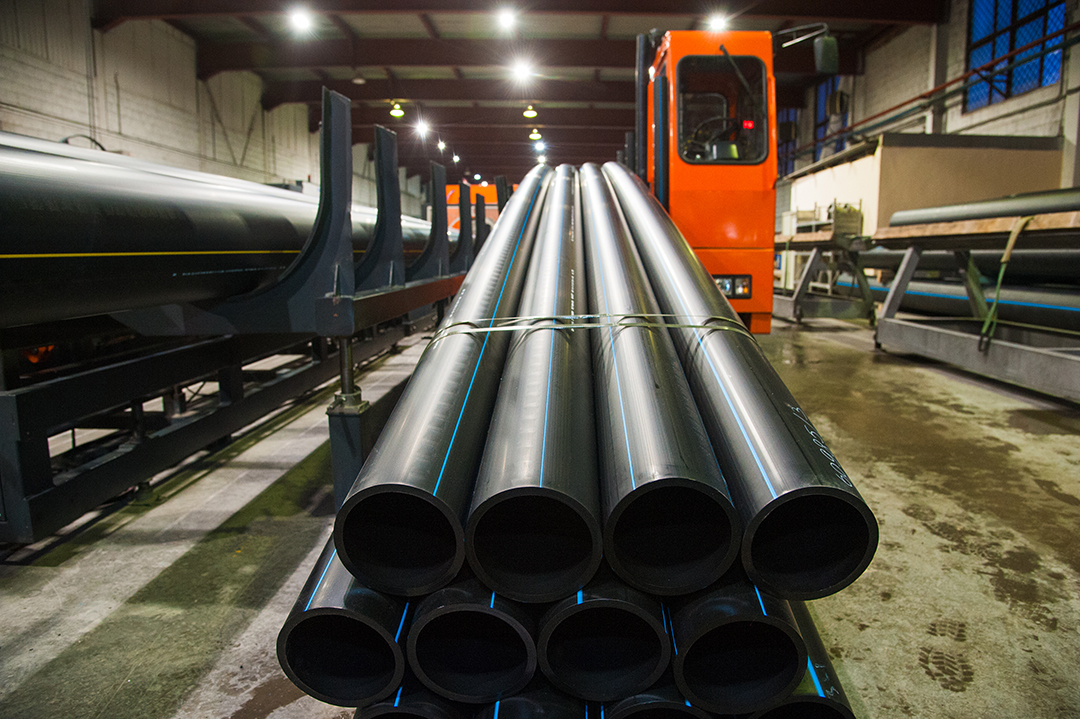
Because of its strength and chemical stability, PE4710 is an excellent material for drainage poly pipe in deep burial, trenchless, and aggressive soil conditions. Its structural reliability allows engineers to design HDPE trench systems that perform consistently over decades when supported by proper installation and quality control.
Hydraulic Behavior and Sizing in Drainage Use
When selecting a drainage poly pipe, contractors evaluate hydraulic capacity, friction loss, and slope requirements. PE4710 is commonly used in smooth-wall HDPE pipe with a Hazen-Williams coefficient near 150, maintaining high flow efficiency and minimizing head loss over time.
The resin’s resistance to scaling prevents buildup and capacity reduction. This makes it well-suited for gravity drainage and wastewater systems that rely on sustained flow rates. Although rated for pressure, its structural strength provides a safety margin in gravity-flow applications where soil loads dominate. Proper pipe sizing, slope, and burial depth remain essential to meeting design flow without deformation or surcharge.
In HDPE trench installations, compaction quality and live loads can affect pipe shape. The inherent flexibility of PE4710 helps maintain cross-sectional integrity and hydraulic performance even under demanding conditions.
HDPE Trench Systems Role and Interaction with PE4710 Drainage Poly Pipe
HDPE trench systems are engineered networks that manage stormwater and subsurface drainage using interconnected pipes, basins, and fittings. These configurations often integrate inlets, lateral lines, and geotextile components to ensure efficient flow and long-term reliability.
Using PE4710 drainage poly pipe in HDPE trench systems offers several benefits:
- Flexibility under settlement: PE4710 adapts to soil movement and reduces the risk of cracking or joint stress.
- High joint integrity: Heat fusion creates continuous joints that minimize leakage and maintenance needs.
- Corrosion and chemical resistance: The material withstands acidic and alkaline conditions often found in industrial sites.
- Compatibility with trenchless installation: Suitable for HDD and slip-lining projects where durability and flexibility are required.
- Extended service life: Properly installed systems can operate effectively for 100 years or more.
Trench design remains critical to performance. Proper bedding, backfill, and compaction distribute soil loads evenly across the pipe. This balance between soil support and material flexibility ensures long-term system stability.
Jointing Methods: Fusion and Field Quality Control
PE4710 drainage poly pipe is fully compatible with heat fusion joining methods such as butt fusion, saddle fusion, and electrofusion. When performed correctly, these joints are as strong as the pipe itself, eliminating common leak points.
Key field practices include:
- Operator qualification: Personnel must follow ASTM F2620 and PPI TR-41 fusion standards.
- Pipe preparation: Ends should be clean, square, and properly heated before fusion.
- Equipment calibration: Fusion machines must match pipe diameter and DR rating.
- Process documentation: Record fusion parameters and maintain logs for quality verification.
- Joint testing: Conduct hydrostatic or tensile testing to confirm weld integrity.
Contractors should also monitor alignment, strain relief, and joint protection during backfill. Even pressure distribution prevents joint stress and ensures a long-lasting seal across the system.
Installation Techniques: Trenchless Options and Guidelines
PE4710 can be installed through open-cut excavation or trenchless methods such as horizontal directional drilling (HDD), slip lining, and pipe bursting. Its strength and flexibility allow it to withstand long pulls and high stress during installation.
The Plastics Pipe Institute’s Model Specification MAB-11-2024 outlines detailed installation procedures for PE4710, including HDD applications. Contractors should consult this standard when developing project plans.
- Pull tension limits: Follow manufacturer stress charts for safe installation.
- Bending radii: Maintain minimum radius guidelines for the chosen pipe diameter.
- Subsurface investigation: Assess soils and groundwater before drilling.
- Lubrication and guidance: Use suitable drilling fluids to prevent abrasion.
- Anchoring and tie-ins: Reinforce transitions at manholes or inlets.
Following these guidelines supports efficient trenchless installations and preserves the structural integrity of PE4710 drainage systems.
Risk Factors, Common Pitfalls, and Mitigation Strategies
While PE4710 offers exceptional performance, certain field issues can compromise results. Contractors should watch for poor fusion workmanship, improper backfill, or misjudged loading conditions. Many of these challenges can be reduced through proactive testing and quality assurance at every stage of construction.
Additional precautions include soil testing, QA/QC documentation, and conservative design margins to protect long-term performance.
How Coastal Resource Group Can Support High-Performance Drainage Projects
Coastal Resource Group provides centralized sourcing and technical support for industrial and infrastructure projects. The company supplies HDPE pipe and fittings, fusion machines, and logistics coordination to contractors throughout Texas and neighboring regions.
Key advantages for drainage professionals include:
- Extensive inventory: Full availability of PE4710 HDPE pipe sizes, fittings, and accessories.
- Fusion support: Access to fusion equipment rentals and qualified technical services.
- Reliable logistics: Fast delivery options with 24/7 coverage for supply emergencies.
- Technical expertise: Guidance in pipe selection, trench design, and fitting integration.
- Procurement efficiency: Consolidated sourcing across drainage, petrochemical, and industrial sectors.
- Quality assurance: Documentation and compliance support to strengthen contractor bids and inspection reports.
Through these capabilities, Coastal Resource Group acts as more than a supplier. The company partners with contractors to deliver precision, consistency, and confidence in every HDPE drainage project.