
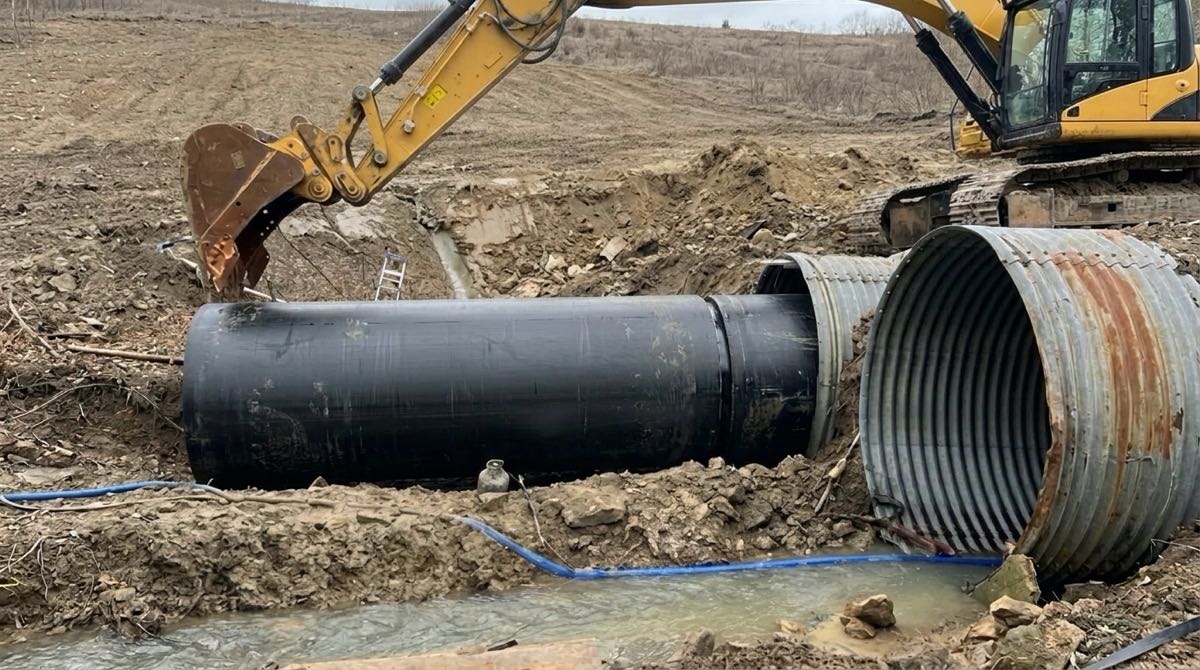
Digging up a failing culvert or deteriorated sewer main is expensive, disruptive, and in many Texas locations, operationally complicated. A 48-inch corrugated metal pipe culvert under a county road doesn’t stop failing because replacing it is inconvenient, but full excavation can mean road closures, shoring, dewatering, and disposal costs that push the project well past what the infrastructure is worth.
Sliplining offers a different path. The method inserts a new HDPE carrier pipe inside the existing deteriorated host pipe, restores hydraulic capacity, and eliminates the corrosion and structural problems driving the failure, without the excavation full replacement requires. It is one of the most cost-effective trenchless rehabilitation options available for culverts, gravity sewers, pressure mains, and oilfield gathering lines across Texas.
Alongside other trenchless methods like horizontal directional drilling and pipe bursting, sliplining rounds out the toolkit Texas contractors use to rehabilitate infrastructure without open-cut disruption. Understanding where sliplining fits, and how to spec the HDPE that goes into it, determines whether a rehabilitation project holds up for decades or creates a new problem within a few years.
How Sliplining Works
A new HDPE pipe, smaller in diameter than the host pipe, is pulled or pushed through the existing deteriorated line via access points at each end. Once in place, the annular space between the two pipes is pressure-grouted, which transfers external loads from the surrounding soil through the host pipe and stabilizes the system against settlement. The result is a structurally restored pipeline with a corrosion-resistant, hydraulically smooth interior.
Two insertion approaches are used in practice. Segmental sliplining uses short HDPE sections assembled inside the access pit and pushed into the host pipe incrementally. Continuous sliplining pulls a pre-fused HDPE string from one end, which is faster on longer runs but requires sufficient staging area at the entry point for the assembled pipe string.
Where Sliplining Works and Where It Doesn’t
The host pipe needs to be structurally intact enough to support the carrier pipe during insertion and to transfer loads once the annulus is grouted. A host pipe with collapsed sections, severe joint separation, or active structural failure is not a candidate. In those situations, pipe bursting or full excavation is more appropriate.
Where sliplining is well-suited:
- Corrugated metal culverts with invert corrosion, joint separation, or section loss that has not yet reached structural failure
- Concrete gravity sewer mains with root intrusion, joint leakage, or interior surface degradation
- Aging water distribution mains with tuberculation or recurring pressure failures
- Oilfield gathering lines with internal corrosion that inhibitor programs can no longer address
- Storm drainage infrastructure where structural and capacity concerns don’t justify full replacement costs
Texas Department of Transportation recognizes sliplining as an approved culvert rehabilitation method for roadway drainage infrastructure. Contractors working on TxDOT-adjacent or county road culverts should reference district-level specifications alongside standard sliplining practice.
The hydraulic trade-off deserves direct attention. Sliplining reduces inside diameter. A 36-inch host pipe sliplined with 30-inch HDPE has less cross-section than the original. But HDPE carries a Manning’s roughness coefficient of approximately 0.009 compared to 0.013 or higher for aged concrete or corrugated metal. In most gravity drainage applications, the smoother interior maintains or improves flow capacity despite the reduced diameter.
Specifying HDPE for Sliplining
The DR rating selected for a sliplining application depends on whether the rehabilitated line carries internal pressure, whether the grouted host pipe provides external structural support, and the depth and traffic loading above the installation.
PE grade. PE4710 is preferred for both gravity and pressure sliplining. Its improved stress crack resistance and long-term hydrostatic strength rating make it the right choice for pipe that will remain in service for 50 years inside a host structure that cannot be easily accessed or replaced.
Gravity sewer and drainage applications. SDR 26 or SDR 35 is commonly used where the grouted host pipe carries the external load. The carrier pipe only needs to handle internal flow and resist point loads during installation.
Pressure main applications. Rehabilitating water distribution mains or low-pressure gathering lines requires a higher-rated pipe. SDR 17 or SDR 11 is standard depending on the operating pressure at the installation point.
Diameter selection. The carrier pipe OD must fit inside the host pipe with adequate clearance for insertion. The general guidance is a carrier pipe OD no larger than 90 to 95 percent of the host pipe ID, accounting for joint bells, accumulated debris, and any in-place deformation of the host pipe.
Connection method. Continuous sliplining requires butt fusion to produce a single fused string pulled through the host pipe. Segmental sliplining may use mechanical joints or butt-fused short segments depending on pipe size and site access.
Texas Applications Where Sliplining Is Most Common
Roadway culverts. Corrugated metal pipe culverts installed under Texas highways and county roads from the 1960s through the 1990s are reaching end of service life. Many are candidates for HDPE sliplining rather than full replacement, particularly on roadways where closure costs and traffic impact make excavation operationally difficult.
Municipal sewer and water mains. Older Texas cities have concrete and clay sewer mains that are decades past design life. HDPE sliplining restores structural integrity and eliminates infiltration and inflow at deteriorated joints without the cost and disruption of open-cut replacement.
Oilfield gathering systems. Carbon steel gathering lines with internal corrosion that has progressed beyond what inhibitor treatment can control are candidates for sliplining with HDPE carrier pipe, particularly on lines where the steel host pipe still provides adequate structural support.
Sliplining Specification Reference
| Variable | Gravity Sliplining | Pressure Sliplining |
|---|---|---|
| Typical DR rating | SDR 26 to SDR 35 | SDR 11 to SDR 17 |
| PE grade | PE4710 preferred | PE4710 required |
| Connection method | Butt fusion or mechanical joints | Butt fusion |
| Carrier-to-host ratio | 90-95% of host pipe ID | 90-95% of host pipe ID |
| Annulus treatment | Sand-cement pressure grout | Sand-cement pressure grout |
HDPE Pipe and Fusion Equipment for Texas Sliplining Projects
Coastal Resource Group stocks HDPE pipe in PE4710 and PE3408 grades across the SDR ratings used in both gravity and pressure sliplining, with two Texas stocking locations and direct delivery to project sites across the state.
- HDPE pipe in SDR 11, SDR 17, SDR 26, and SDR 35 for gravity and pressure rehabilitation applications
- Large-diameter HDPE for municipal culvert and sewer main sliplining projects
- McElroy butt fusion equipment for fusion machine rental on projects requiring fused pipe strings at the entry point
- Same-day delivery to South Texas, Gulf Coast, and Central Texas project sites
If you’re looking for HDPE pipe for a culvert or pipeline rehabilitation project in Texas, contact us or call 888-841-7954 to confirm the right DR rating, PE grade, and carrier pipe diameter for the host pipe conditions on your project.