PE 40 HDPE for Cable Protection: What You Need to Know
If you’re running cables underground and need something to protect them, PE 40 HDPE conduit is probably going to be your best friend. It’s that black plastic tubing you see getting pulled through trenches and bored holes everywhere – and there’s good reason it’s so popular.
Whether you’re running a single fiber drop to a house or laying miles of cable across the countryside, PE 40 gives you that bulletproof protection your cables need to survive decades underground. It’s the kind of product that just works – keeping water out, rodents at bay, and your cables safe from the chaos of construction sites and the slow grind of time.
What Industries Use PE 40?
Pretty much every industry that runs cables underground has discovered PE 40. Heavy industrial facilities like chemical plants, refineries, steel mills, and mining operations rely on it because these places have harsh chemicals in the soil, heavy machinery overhead, and cables that absolutely cannot fail. These facilities run miles of instrumentation and control cables that monitor everything from temperature to pressure to toxic gas levels.
Construction sites are brutal on cables, so PE 40 protects everything from temporary power feeds to permanent building systems. It’s tough enough to survive concrete pours, heavy equipment traffic, and the general chaos of active job sites. From high-rise buildings to highway projects, contractors know they can count on PE 40 to keep their cables intact.
Marine and waterfront facilities present their own challenges. Ports, shipyards, offshore platforms, and waterfront facilities all deal with salt water and marine environments that want to eat infrastructure alive. PE 40 shrugs off saltwater intrusion and keeps critical navigation, communication, and power systems running year after year.
Manufacturing environments like automotive plants, food processing facilities, pharmaceutical companies, and paper mills can’t afford downtime that costs thousands per minute. Control cables, network connections, and monitoring systems all get the PE 40 treatment because reliability is everything in these operations.
Beyond heavy industry, you’ll find PE 40 protecting cables in telecom and fiber installations from neighborhood fiber drops to transcontinental backbone routes. Electric utilities use it for distribution lines, substation connections, street lighting, and smart grid infrastructure. Transportation systems including highways, railways, airports, and seaports depend on it for all the infrastructure that keeps people and goods moving. Energy projects like solar farms, wind installations, oil and gas facilities, and power generation plants all rely on PE 40 for their critical cable protection needs.
What Types of Cables Can You Protect?
PE 40 doesn’t discriminate – it’ll protect whatever you need to run through it. Fiber optic cables range from single-fiber drops serving individual homes to massive 864-count backbone cables carrying terabytes of data across states and countries. Power cables include everything from low-voltage control wiring in industrial plants to medium-voltage distribution lines serving neighborhoods, and even high-voltage transmission cables when you use larger diameter conduits.
Communication cables of all types find protection in PE 40, including coax for cable TV systems, twisted pair for phone and data networks, and hybrid cables that combine multiple signal types in one package. Control and instrumentation applications cover thermocouple wires measuring temperatures in industrial processes, 4-20mA current loops controlling equipment, digital communication buses connecting distributed systems, and SCADA networks monitoring critical infrastructure.
Specialty cables get PE 40 protection too, including fire alarm circuits that can’t fail during emergencies, security system wiring protecting valuable facilities, traffic control cables managing busy intersections, railway signaling systems keeping trains safe, and even military and aerospace applications where failure simply isn’t an option.
Why Choose PE 40 for Cable Protection?
Think of PE 40 as the goldilocks of cable conduit – not too stiff, not too flimsy, but just right. It bends without breaking, so you can route it around obstacles and through tight spots without cracking or kinking, though you still need to respect the bend radius limits. The material is tough as nails, shrugging off rocks in backfill, heavy equipment driving overhead, chemical-laden soil, and all the other abuse that underground infrastructure faces over decades of service.
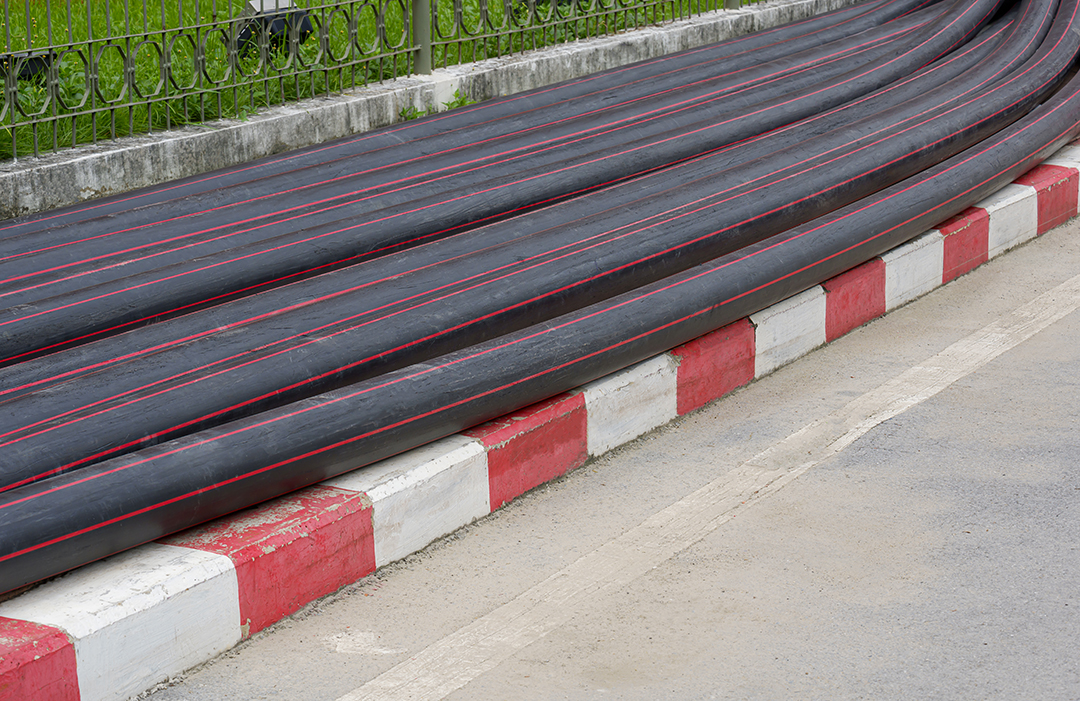
Cables slide through PE 40 easily thanks to its smooth inside wall, which means less friction when you’re pulling cable. This saves your back during installation and protects your cable jackets from damage. Despite those big coils looking intimidating, PE 40 is surprisingly lightweight and much easier to handle than you’d expect. Unlike metal conduit, you’ll never have to worry about corrosion eating through your protection – PE 40 just doesn’t rust, period.
What Does PE 40 Keep Out?
This stuff is like a fortress for your cables, protecting against the many threats that can destroy expensive cable installations. Water is the big killer of cables, and PE 40 creates a watertight barrier when properly installed and joined, keeping groundwater, surface flooding, and moisture away from your cable runs. It keeps dirt and debris from working into cable jackets and connections over time, preventing the slow degradation that can kill cables.
Rodents like gophers and rats love to chew on cables, but PE 40 gives them a mouthful of tough plastic instead of expensive copper or fiber. Insects including termites and ants that can damage cables over time find PE 40 an impenetrable barrier. Industrial soils, road salt, fertilizers, and other chemicals that would eat cable jackets alive just bounce off PE 40’s chemical-resistant surface.
Mechanical damage from rocks in backfill, future excavation, ground settling, and the occasional backhoe operator having a bad day all get stopped by PE 40’s tough construction. While most cables are buried, transitions and above-ground sections get full UV protection, and the conduit provides thermal mass that protects against rapid temperature swings that can stress cable materials.
Can You Use It for Long Runs?
Here’s where PE 40 really shines – you can go as short or as long as your project demands. Standard coils start at 250 feet and go up to 1,000 feet or more for smaller diameters, perfect for neighborhood installations, building connections, or campus networks where you want continuous runs without joints.
For long haul applications, PE 40 can be ordered in custom lengths of several thousand feet per reel, or you can join multiple sections together for virtually unlimited distance. Major utility and telecom projects routinely use PE 40 for runs measured in miles, not feet. The key is having reliable joining methods that maintain the integrity of your cable protection system.
When you need to connect pieces of PE 40 or repair damage, mechanical couplings offer the quick and easy solution that works for most applications – just slip the coupling over both ends and tighten the clamps. For permanent, watertight connections that are as strong as the original conduit, heat fusion uses specialized equipment to literally melt the plastic together. Electrofusion uses special fittings with built-in heating elements and costs more but creates perfect joints every time. Socket fusion works well for connecting to fittings and accessories.
The fusion methods create joints that are actually stronger than the original pipe – you literally can’t tell where the original conduit ends and the joint begins. This means your protection system maintains full integrity even across miles of cable runs.
How Do You Get It Packaged?
The way you get PE 40 depends on what size you need and how you’re installing it. Smaller diameters typically come in coils on reels, which are easy to transport and deploy with plows or directional drills. You get long continuous runs with no joints, which speeds installation and reduces potential failure points.
Larger sizes usually come in straight lengths, typically 20-foot or 40-foot sticks that are easier to handle in tight spaces or for vault-to-vault work. Your supplier can often provide custom lengths that match your exact project needs, and sometimes that saves you significant money in waste and labor costs.
What Affects Your Cost?
Nobody likes surprises when the invoice shows up, so understanding what drives PE 40 costs helps you plan better projects. Size matters – bigger diameter and thicker walls cost more, but you might need them for your specific application and loading conditions. How it’s packaged affects price too, with coils versus straight lengths, reel sizes, and footage per reel all playing into the total cost equation.
Special features like different colors, UV protection packages, identification stripes, and custom printing add cost but can save money during installation and maintenance. Value-add options including pre-installed pull rope, detectable tracer wire, and end caps cost more upfront but often pay for themselves in installation efficiency.
Don’t forget about accessories and joining methods, as fusion equipment rental, couplings, sweeps, and vault hardware can add up quickly. Logistics factors like freight distance, delivery timing, liftgate service, and special jobsite handling requirements all impact your bottom line. Your installation method also matters – some packaging works better with plows, others with directional drills or open trenching, and the right choice can save significant labor costs.
The key is thinking through your whole project, not just the per-foot price. Sometimes paying more upfront for better packaging or accessories saves you big money in the field.
What Should You Specify?
Clear specifications prevent rework and delays that can kill project budgets and schedules. Size and wall thickness need to match your cables and installation conditions – too small and you can’t pull your cables, too thin and the conduit might not survive installation or burial loads.
Color and markings matter more than you might think. Black is standard and includes UV protection, but orange for telecom and red for electrical are common specifications too. Tracer stripes or custom printing can save you headaches later when you’re trying to figure out which duct carries what cables.
Think about packaging in relation to your installation method. Long coils work great for plowing and HDD applications where you want continuous runs. Straight lengths make sense for vault work and tight spaces. Match your reel sizes to what your equipment can handle, and consider custom lengths that eliminate waste and reduce splicing.
Don’t forget about accessories and joining components. Couplings, bends, pull tape, tracer wire, and other items are cheaper to order with your conduit than to scramble for later. If you’re using fusion joining for pressure applications or water-tightness, make sure you specify compatible ends and procedures.
Any Installation Tips?
Following proper installation practices ensures your PE 40 conduit will outlast your career. Respect the bend radius limits for every diameter – exceeding them causes stress concentrations that can lead to failures down the road. Use proper pulling techniques including appropriate lubricants, reasonable tension limits, and always check your path before starting a long cable pull.
Backfill carefully with clean material free of sharp rocks, and compact according to specifications to prevent settling that could damage your installation. Consider warning tape or detectable marker systems above the conduit run – this saves someone from accidentally digging up your cables years later when everyone’s forgotten exactly where they’re buried.
For fusion joining, invest in proper training and equipment. Good fusion joints are stronger than the original pipe, but bad ones can fail catastrophically. Always test your joints and document your procedures for consistent results across your project.
Bottom Line
PE 40 HDPE conduit is popular because it simply works. It’s flexible enough for tricky installations, tough enough for harsh conditions, and affordable enough that you won’t blow your budget. The key is specifying it correctly for your particular application and installation method.
Whether you’re protecting a single fiber drop or miles of backbone cable, PE 40 creates a reliable environment that keeps your cables safe from water, rodents, chemicals, mechanical damage, and all the other threats that can destroy expensive cable installations. Just make sure you get the sizing, wall thickness, packaging, and accessories right for your specific project, and PE 40 will keep your cables protected for decades.
Need to source PE 40 for your next project? Companies like Coastal Resource Group can help you figure out exactly what you need and get it delivered when and where you need it.