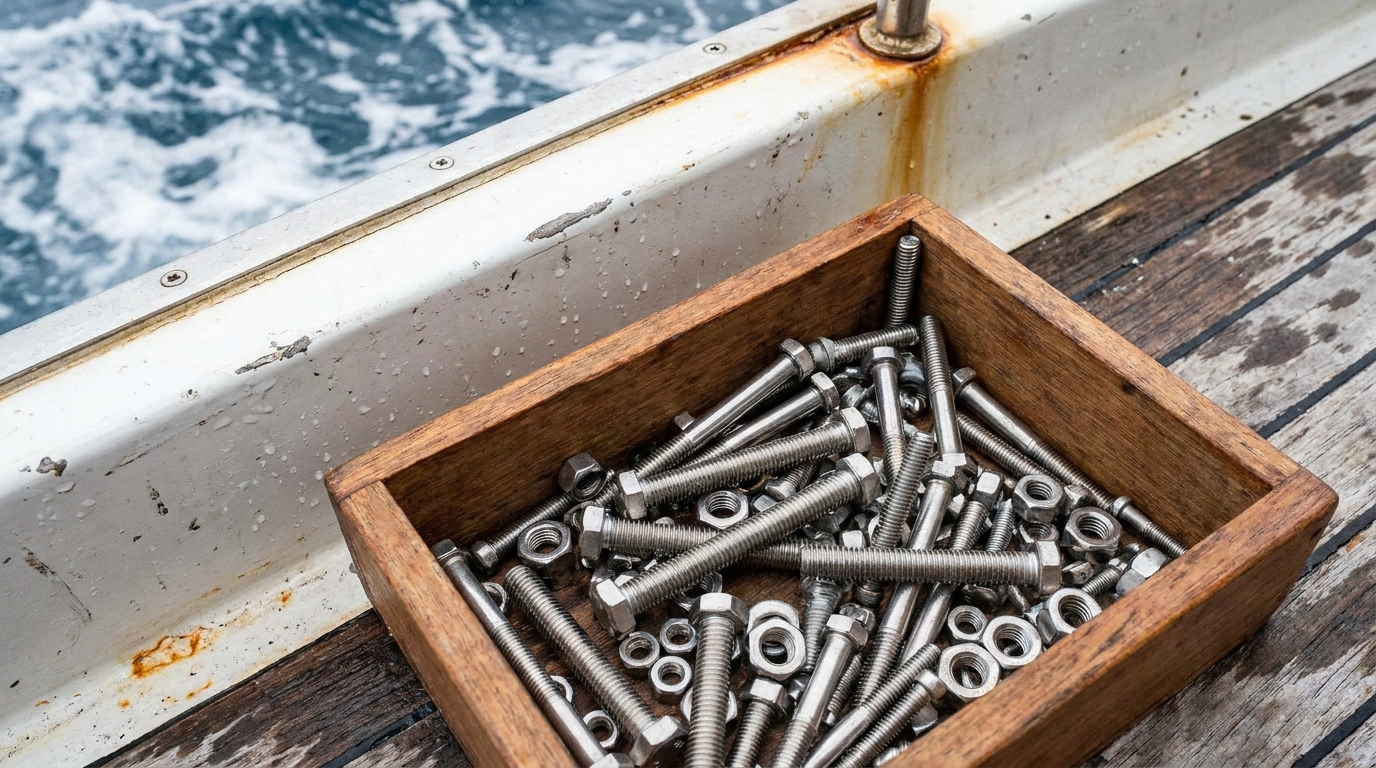
Marine-grade fasteners are a classification of threaded hardware engineered specifically to resist electrochemical corrosion in environments where chloride ions, moisture, and oxygen accelerate metal degradation beyond the tolerance of standard carbon steel or zinc-coated fasteners. The classification is not decorative. Whether used as structural bolts in dock framing or fasteners on offshore platforms, the material specification determines service life. In saltwater environments, the wrong fastener material does not fail slowly. It fails structurally, at connection points, under load, and often without visible warning on the surface.
What Saltwater Does to Metal Fasteners
The corrosion mechanism in a saltwater environment is electrochemical, not simply chemical. When a metal fastener contacts saltwater or salt-laden air, sodium chloride dissociates into chloride ions that aggressively attack the protective oxide layer on the metal surface. This oxide layer, called the passive film, is what prevents bare steel and most alloys from corroding under normal atmospheric exposure. Chloride ions penetrate and destabilize this film at a rate that increases with ion concentration, temperature, and the presence of oxygen. The science governing this degradation process is documented in depth by AMPP, the professional body dedicated to corrosion engineering and materials protection.
Three corrosion mechanisms operate in saltwater environments, and all three can affect a single fastener depending on its location, geometry, and the metals it contacts.
- Pitting corrosion is the localized dissolution of the base metal that creates cavities below the surface, while the fastener may appear intact from the outside. Pitting is particularly destructive in structural fasteners because the stress concentration at a pit can initiate cracking under loads that the unaffected cross-section would handle without failure.
- Crevice corrosion occurs in confined spaces where oxygen is depleted and chloride ions concentrate. Under a washer, inside a threaded connection, or between a fitting and a submerged timber are all locations where crevice corrosion can start. The geometry that holds the fastener in place is the same geometry that creates the conditions for its accelerated degradation.
- Galvanic corrosion occurs when two metals with different electrochemical potentials are placed in electrical contact through an electrolyte. Saltwater is an effective electrolyte. A carbon steel bolt connected to a stainless steel fitting creates a galvanic cell where the carbon steel, being the less noble metal, corrodes preferentially. Understanding which metals are noble relative to one another is a prerequisite for any marine fastener specification that involves mixed-material assemblies.
Salt Spray Resistance and How It Is Measured
Salt spray resistance is the quantified ability of a fastener material or coating to resist visible corrosion under standardized salt fog conditions. The governing standard is ASTM B117, which specifies a continuous mist of 5% sodium chloride solution applied at 95 degrees Fahrenheit. The result is reported as the number of hours before red rust or white corrosion product appears on the specimen surface.
Salt spray hours are a comparative screening tool, not a field service life predictor. Real-world marine environments introduce wetting and drying cycles, UV exposure, mechanical stress, biological fouling, and variable chloride concentrations that the laboratory test does not replicate. A fastener rated for 1,000 hours in a salt spray cabinet may perform for 10 years on an above-waterline dock connection or fail within two years in a fully submerged tidal zone. The test gives a ranked comparison between materials, not an absolute number.
The performance bands most relevant to marine bolt specs are:
- Hot-dip galvanized carbon steel: 500 to 1,000 hours, depending on coating thickness
- Mechanical zinc plating: 200 to 500 hours
- Type 304 stainless steel: 500 to 1,000 hours in open exposure, but vulnerable to crevice corrosion with static saltwater contact
- Type 316 stainless steel: exceeds 1,000 hours and resists crevice corrosion through its molybdenum content of 2-3 %
- Duplex stainless 2205: exceeds 2,000 hours and provides greater tensile strength than 316
Marine Bolt Specs by Material
Marine bolt specs define the alloy, grade, and sometimes the surface treatment required for a fastener in a specific corrosive environment. The four materials that cover the majority of coastal and offshore fastener applications are Type 316 stainless steel, duplex stainless steel, silicon bronze, and hot-dip galvanized carbon steel. Each has a defined performance range, a set of appropriate applications, and a set of conditions under which it should not be used.
Type 316 Stainless Steel
Type 316 stainless steel is the baseline material specification for marine fasteners in direct saltwater exposure. Its composition includes 16-18% chromium, 10-14% nickel, and 2-3% molybdenum. The molybdenum content differentiates 316 from 304 by improving resistance to pitting and crevice corrosion in chloride environments. When fastener specifications reference A4 grade per ISO 3506, they are specifying 316 stainless or an equivalent molybdenum-bearing austenitic alloy.
316 stainless is appropriate for submerged dock hardware, pier framing connections, gangway hinges, and above-waterline coastal structural assemblies. It is not immune to crevice corrosion. In oxygen-depleted tight joints at or below the waterline, 316 stainless steel will corrode at the crevice even when open surfaces remain unaffected. For connections in that condition, the specification steps up to duplex or incorporates isolation geometry.
Duplex Stainless Steel
Duplex stainless steel, specifically the 2205 grade, has an austenitic-ferritic dual-phase microstructure that provides roughly twice the yield strength of 316 stainless and substantially better resistance to stress corrosion cracking and pitting in high-chloride environments. It is the preferred specification for dynamically loaded marine connections: suspended dock sections under tidal movement, lifting hardware on marine structures, and wave-affected framing assemblies where cyclic stress amplifies the risk of corrosion-assisted cracking. The performance characteristics of austenitic stainless bolts in coastal environments are covered in detail for applications where alloy selection directly affects structural service life.
Duplex stainless steel costs more than 316 stainless steel and has more limited availability outside of specialized industrial suppliers. In applications where the load case and exposure condition justify it, the material cost is the smaller portion of the total risk.
Silicon Bronze
Silicon bronze is an alloy of copper, silicon, and small amounts of zinc or manganese. It does not rust, it is compatible with treated lumber and composite decking materials, and it performs well under cyclic loading in wooden marine construction. Its long record in boat building and dock construction comes from its combination of corrosion resistance and fatigue tolerance in wood-fastener assemblies.
The primary limitation of silicon bronze is tensile strength. Its yield strength is significantly lower than structural stainless grades, which limits its appropriate use to wood-to-wood connections, light hardware, and non-structural fasteners. Specifying silicon bronze for primary structural bolt connections in high-load dock assemblies is an error.
Hot-Dip Galvanized Carbon Steel
Hot-dip galvanized carbon steel fasteners are coated with zinc at a thickness that typically exceeds 43 microns. The zinc provides sacrificial protection: it corrodes preferentially in the presence of an electrolyte, protecting the underlying steel. This mechanism is effective in onshore coastal construction where salt air exposure is periodic and direct saltwater immersion is absent.
Hot-dip galvanized fasteners are not appropriate for submerged applications. Cut threads expose bare steel at thread roots, creating unprotected sites at the most mechanically stressed portion of the fastener. In splash zone and tidal applications, the zinc depletes within one to three years, depending on exposure intensity, leaving unprotected carbon steel in one of the most aggressive corrosion zones in the marine environment.
Dock Fastener Specifications by Exposure Zone
Dock structures divide into three corrosion exposure zones, and fastener specifications should be assigned by zone rather than applied uniformly across the structure.
The submerged zone covers all connections below the mean low water line. Fasteners here are in continuous saltwater contact with restricted oxygen availability. Minimum and upgrade specifications are:
- Type 316 stainless, A4 grade per ASTM A193 equivalent standards, with matching nuts and washers as the minimum
- Duplex 2205 stainless steel, where the connection geometry creates crevice conditions
- Nylon or HDPE isolation washers where stainless fasteners contact aluminum or galvanized structural components
Mixing fastener alloys within the same connection introduces a galvanic risk at the interface and should be avoided in all submerged assemblies. The principles governing corrosion-resistant bolt selection in water-contact systems apply equally to submerged marine connections and potable water infrastructure.
The splash zone covers the area between mean low water and two to three feet above mean high water. Repeated wetting and drying cycles concentrate chlorides at the metal surface during each drying phase, making this the most aggressive corrosion zone in any marine structure. Specification options for this zone are:
- Type 316 stainless steel with Xylan or fluoropolymer coating for cost-effective protection
- Duplex 2205 uncoated steel fasteners, where long service intervals and minimal maintenance access are priorities
The atmospheric zone covers framing and decking connections above the tidal influence that are exposed to salt air but not direct saltwater contact. Hot-dip galvanized structural bolts meeting ASTM A307 or A325, with 316 stainless hardware at exposed connection points, balance cost and corrosion performance appropriately for most Gulf Coast dock projects in this zone.
Marine Fastener Installation Requirements
Stainless steel fasteners require anti-seize compound on threads before installation. Austenitic stainless alloys, including 316 and duplex grades, are susceptible to galling, a cold welding mechanism where threads fuse under torque. Galling can make a fastener impossible to remove without destruction and occurs rapidly when stainless threads contact stainless threads without lubrication. Nickel-based anti-seize is the standard compound. It does not reduce clamping force when torque is applied correctly.
Torque values for corrosion-resistant alloys differ from carbon steel values. Silicon bronze and 316 stainless steel have lower hardness than structural carbon steel, which makes thread stripping a failure mode under over-torquing. Published torque tables from the fastener manufacturer for the specific alloy and thread form are the correct reference. Carbon steel torque values applied to stainless or bronze fasteners will damage threads.
Inspection intervals define whether a correctly specified fastener remains a correctly performing one. Marine fasteners degrade over time, even when initially specified correctly. Annual inspection of dock hardware should cover:
- Pitting depth at exposed fastener surfaces
- Crevice corrosion at the contact surfaces between the fastener, washer, and substrate
- Elongation or necking at loaded connection points
- Coating condition on galvanized or coated fasteners in splash and atmospheric zones
Fasteners showing pitting that penetrates more than 25% of the cross-section should be replaced before load-bearing capacity is affected.
Sourcing Marine and Industrial Fasteners in Texas
For industrial and construction operations across South Texas and the Gulf Coast, fastener availability on short timelines is a procurement constraint that material specification cannot ignore. Emergency repairs to dock infrastructure, oilfield saltwater disposal line tie-ins, and coastal construction projects require suppliers with stocking inventory and same-day fulfillment capability.
Coastal Resource Group supplies marine-grade bolts built to resist corrosion, along with a full range of bulk industrial fasteners and industrial flange bolts across its South Texas and East Texas locations. Project-specific marine bolt specs, AML-compliant sourcing, and bulk procurement for dock, offshore platform, and coastal infrastructure applications are available after a direct consultation with our team.