
Connecting Galvanized Pipe Without Threading
A cracked or corroded galvanized fitting rarely waits for a convenient time to fail. If the reamer or die needed to cut new threads is not sitting on the truck, a simple repair turns into a supply run and a delayed shutdown. Mechanical couplings solve that problem without cutting a single new thread, and several options exist depending on the pressure, pipe size, and how permanent the connection needs to be.
Why Threading Galvanized Pipe on Site Gets Complicated
Threading galvanized pipe removes the zinc coating at the cut, exposing bare steel right at the connection point. That exposed steel becomes the first place corrosion starts, which defeats the purpose of specifying galvanized pipe in the first place. This is the same reason crews look for non-welded connection methods on stainless steel pipe, since any process that damages a protective coating or finish creates a new failure point. Field threading also requires a pipe threader, cutting oil, and enough clearance to work the tool, none of which is guaranteed on a tight retrofit or an overhead run. When a fitting has already failed and water or process fluid is on the floor, waiting on the right tool is not always an option.
Compression Couplings for Galvanized Repairs
Compression couplings clamp onto the outside of the pipe and seal with an internal gasket, so no threads are involved at all. They are one of the most common pipe fittings stocked for emergency repairs because installation takes minutes with basic hand tools. Most compression couplings are rated for moderate pressure service and work well on straight repairs where the pipe ends are cut clean and round. They are not a permanent fix for high-vibration lines, but for a straight section of galvanized water or utility pipe, they hold reliably for years.
Grooved Mechanical Couplings
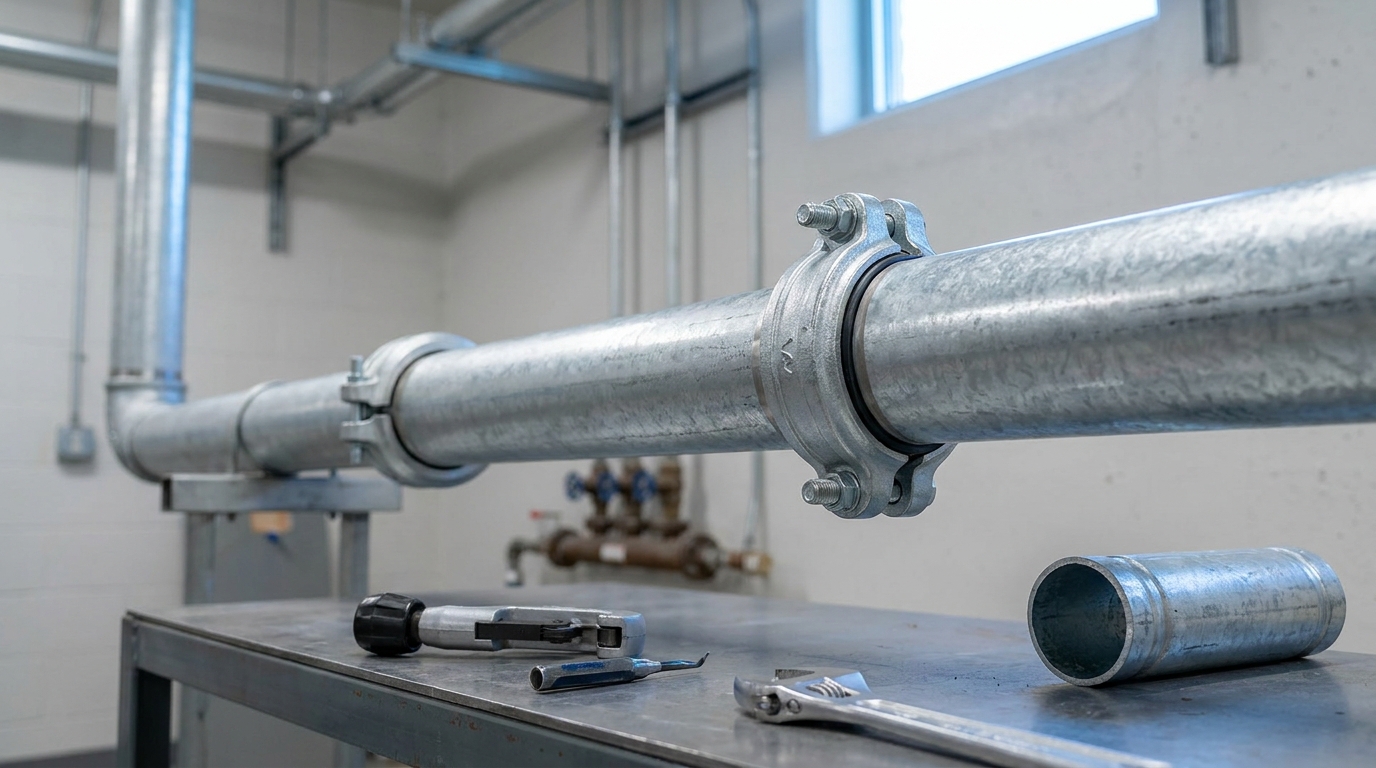
Grooved couplings require a roll groove cut into the pipe end, but that groove is a mechanical shape, not a thread, so the zinc coating stays intact everywhere except the narrow groove itself. Once grooved, the pipe accepts a two-piece housing and gasket that locks the joint under a wide range of pressures. Grooved systems are the standard in fire protection and municipal water work because they allow fast disassembly for maintenance without regrooving the pipe. According to the American Water Works Association, grooved and mechanical joint systems remain a preferred method for water distribution piping where speed of installation and future serviceability both matter.
Flanged Connections Without New Threads
Where a galvanized line ties into a flanged system, a slip-on or weld-neck flange adapter can be fused or welded onto the pipe end rather than threaded. This approach is more common on larger diameter galvanized pipe used in industrial or municipal applications, where the connection needs to match existing flanged valves or equipment. It requires more setup than a compression or grooved coupling, but it produces a joint that matches the pressure rating of the surrounding flanged system rather than being limited by a coupling’s rating.
Push-Fit and Repair Clamps for Emergency Fixes
Push-fit couplings and full-circle repair clamps exist specifically for the moment a line has already failed and the crew needs water or product flow stopped immediately. Push-fit fittings seat over a cleaned pipe end and grip internally, with no tools beyond a pipe cutter and deburring tool. Repair clamps wrap directly over a crack or pinhole leak and are meant as a stabilizing fix until a permanent coupling or section replacement can be scheduled. Neither is intended as the final repair on a long-term basis, but both keep a facility running without an unplanned outage.
| Method | Tools Required | Typical Pressure Range | Best Use |
|---|---|---|---|
| Compression coupling | Pipe cutter, wrench | Low to moderate | Straight repairs, utility lines |
| Grooved coupling | Roll grooving tool, wrench | Moderate to high | Fire protection, water distribution |
| Flanged adapter | Welding or fusion equipment | Matches flange class | Ties into existing flanged systems |
| Push-fit or repair clamp | Pipe cutter, deburring tool | Low, temporary | Emergency stabilization |
How Coastal Resource Group Keeps Galvanized Repairs Moving
A galvanized line does not always fail on a schedule, and the right coupling for the job depends on the pipe size, the pressure class, and how permanent the fix needs to be. Coastal Resource Group stocks fittings, flanges, and bolts across both Texas locations so crews are not stuck waiting on a single part to finish a repair.
- Compression and grooved couplings in common galvanized pipe sizes
- Flanges and flange bolts for permanent tie-ins
- Two Texas locations for faster regional pickup and delivery
- 24/7 emergency supply support for unplanned failures
Cutting new threads is not always the fastest or the most reliable way to get a galvanized line back in service, and picking the wrong coupling for the pressure and application creates its own callback. If you need the right fitting matched to your repair, request a quote from Coastal Resource Group or call 888-841-7954.