
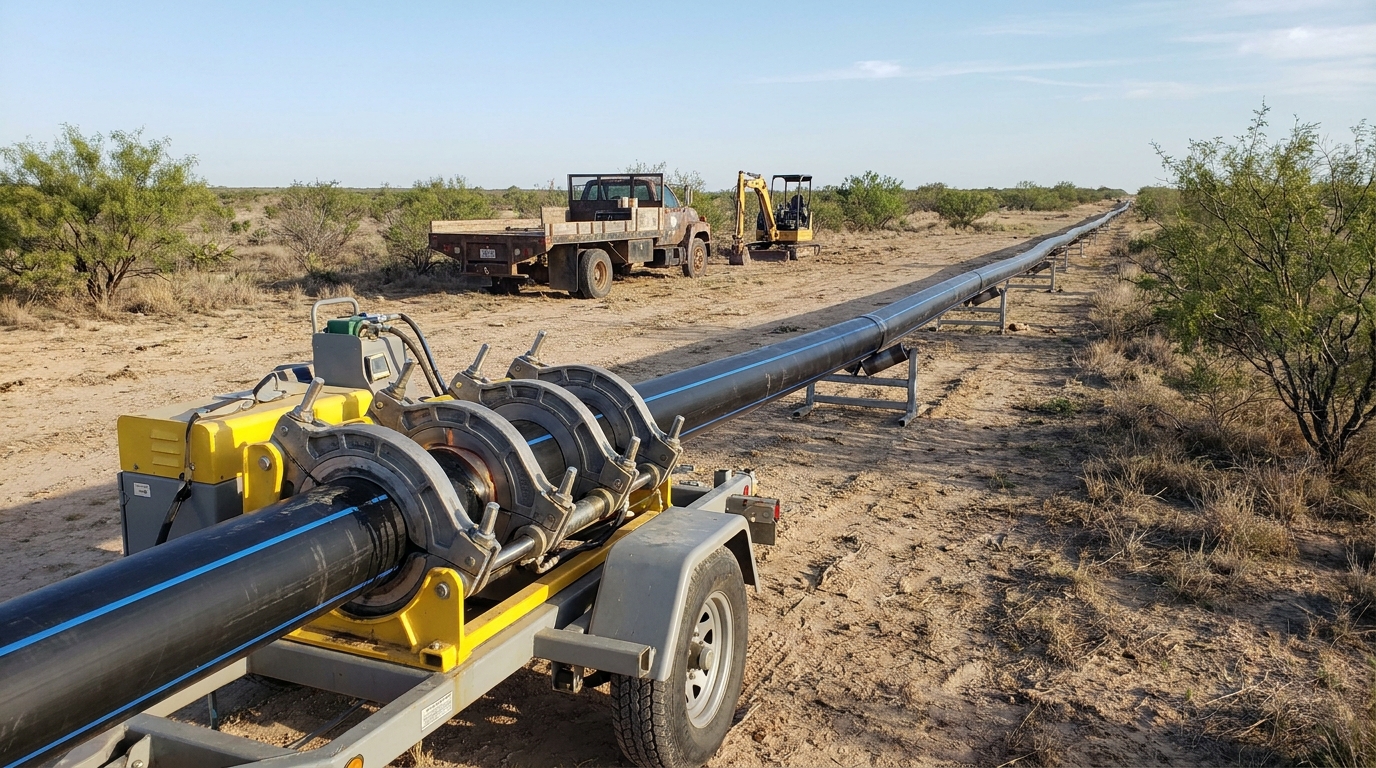
Every contractor running HDPE pipe installations faces this question sooner or later: rent a fusion machine for the job, or buy one and have it available for every job. It sounds like a clean numbers decision. In practice, it’s easy to get wrong in either direction, and the financial consequences compound faster than most people expect.
Here’s how to map out the decision clearly, and when fusion machine rental wins even for contractors who run steady HDPE work year-round.
What Goes Into the True Cost of Owning a Fusion Machine
Buying a fusion machine looks like the obvious move for contractors who run HDPE work regularly. No rental scheduling, no daily rates accumulating on a long project, no logistics around machine availability. But the real cost of ownership extends well beyond the purchase price.
A McElroy butt fusion machine capable of handling 4-inch to 16-inch pipe typically runs $20,000 to $60,000 or more depending on pipe size range, carriage configuration, and hydraulic capacity. Machines sized for larger diameter pipe push considerably higher. That’s before the ongoing costs most contractors underestimate:
- Annual inspection, calibration, and maintenance to keep the machine within McElroy’s operating specifications
- Operator training and qualification requirements, which vary by project type and owner contract requirements
- Transport, rigging, and storage logistics between job sites
- Repair costs and crew downtime when a component fails in the field
- Capital tied up in equipment that may sit unused for months between HDPE jobs
The Plastics Pipe Institute publishes installation and joining standards that govern HDPE fusion work regardless of how the equipment is sourced, but how the machine is maintained between projects and who pays for that is entirely the owner’s cost to carry.
When Rental Makes More Financial Sense
Rental wins in more situations than most contractors initially assume. The clearest cases are short-duration projects, jobs that require a pipe size range outside what an owned machine covers, and work that clusters around a single large project rather than distributing consistently across the year.
Consider a pipeline crew working a three-week HDPE installation in West Texas. Renting a machine for that window costs a fraction of what ownership would require, with no capital outlay, no maintenance obligation, and no storage problem once the job wraps. The rental provider handles the machine; the crew handles the work.
Rental also solves a problem that ownership creates: pipe size flexibility. A contractor who buys a machine sized for 6-inch to 12-inch HDPE is locked into that range for every job. When a project comes up requiring 16-inch or 24-inch pipe, they are renting anyway. Access to a rental fleet spanning 2-inch socket fusion equipment up to 63-inch rolling machines means the right machine is available for each specific job, not just the jobs that happen to fit the owned machine.
For oilfield and gathering system work, project windows are often defined by the operator’s completion schedule, not the contractor’s equipment calendar. Rental lets a crew mobilize quickly with exactly the machine the job requires, without waiting on shop availability or pulling equipment off another active project.
The Productivity Factor That Gets Left Out of the Math
Machine downtime is a project-killer. When an owned fusion machine develops a hydraulic problem or a heating element fails on a job site, the crew stops working. Getting a repair completed can take days depending on parts availability, and the idle labor cost compounds with every hour the machine is down.
Rental fleets that deliver to job sites handle this differently. If equipment has a problem, the rental provider can often swap the unit rather than waiting on a repair cycle. For time-sensitive projects where idle crew time translates directly into cost overruns, that reliability has a dollar value that does not appear in a simple rent-vs-buy comparison.
For contractors working in the Permian Basin, Eagle Ford, or Gulf Coast markets, on-site delivery matters as much as availability. A machine sitting at a warehouse in Houston does nothing for a crew staged near Midland at first light. The McElroy fusion rental program at Coastal Resource Group is built around Texas job site logistics, not warehouse pickup that leaves the field crew to solve the last hundred miles on their own.
Rent vs. Buy at a Glance
| Factor | Ownership | Rental |
|---|---|---|
| Upfront cost | High ($20K to $60K+) | None |
| Best fit | High-volume, year-round HDPE work | Project-by-project or seasonal work |
| Pipe size flexibility | Limited to purchased machine range | Full range available per job |
| Maintenance responsibility | Owner | Rental provider |
| Downtime risk | Higher — repair cycle on the contractor’s clock | Lower — swap options often available |
| Storage and transport | Contractor responsibility | Delivered and retrieved by provider |
| Capital allocation | Tied up in equipment | Available for materials and labor |
Where Ownership Wins the Argument
Ownership is harder to beat when a contractor runs continuous HDPE installation work across the calendar year, operates within a consistent pipe size range a single machine covers, and has the infrastructure to maintain and transport equipment properly. At that volume, the effective daily cost of an owned machine can drop below rental rates, and having equipment on-call without scheduling overhead has genuine operational value.
The threshold varies by region and project type, but contractors running HDPE fusion work more weeks of the year than not, across a predictable pipe size range, are usually the ones who see real economic return from ownership. For everyone else, tying capital into a machine that spends more time in storage than on a job is a harder argument to make.
The honest question is not whether to own a fusion machine, but how many weeks per year that owned machine is producing revenue. If that number is consistently high, ownership pencils out. If it is not, rental is almost always the better allocation of capital, even when HDPE work is a core part of the business.
Fusion Equipment and HDPE Pipe Supply Across Texas
Whether a project calls for rented equipment or a crew that already owns its machine and needs pipe, CRG stocks a full range of HDPE pipe, fittings, and fusion equipment under one roof at two Texas locations.
- Fusion machine rental inventory – McElroy butt fusion, socket fusion, and rolling machines available from 2″ to 63″
- Houston fusion equipment rental – same-day availability for Gulf Coast and Houston-area projects
- Eagle Ford fusion machine rental – on-site delivery for oilfield job sites across Karnes, DeWitt, and surrounding counties
- HDPE pipe in full DR and PE grade ranges, stocked at East Texas and Seguin locations for same-day regional delivery
If you’re looking at a project where the rent-vs-buy math is unresolved, or need McElroy fusion equipment delivered to a Texas job site on short notice, contact us at 888-841-7954 or use the contact page to talk through what the job requires.