
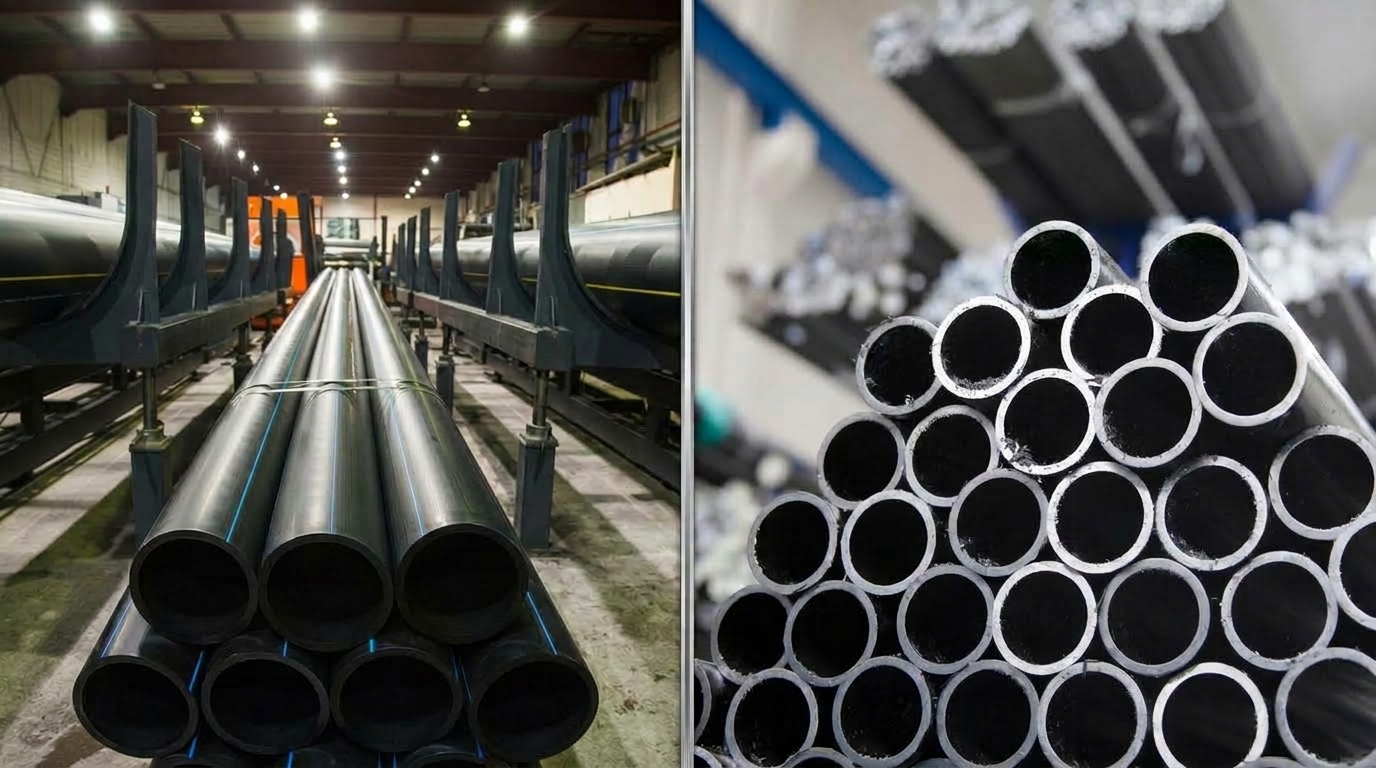
A lower per-foot quote on steel pipe looks good on a bid sheet. It rarely holds up once welding crews, coating inspections, and corrosion allowances get added to the job. Contractors who specify by material price alone often end up paying the difference somewhere else on the project.
HDPE pipe and steel pipe solve the same basic problem in very different ways, and the total installed cost between them depends on more than what shows up on a price list. Here is where the numbers actually diverge on a Texas pipeline job.
Material Price Is Only the Starting Line
Steel pipe generally carries a lower raw material cost per foot than HDPE at comparable pressure ratings, especially in smaller diameters. That gap narrows or reverses once wall thickness, coating requirements, and corrosion allowance get factored into the steel spec.
HDPE pipe is sold by DR rating rather than schedule, and a properly specified PE 100 HDPE pipe or PE 4710 resin carries no coating cost, no cathodic protection system, and no field-applied corrosion barrier. The material price comparison only tells part of the story, which is exactly the trap procurement teams fall into when comparing quotes side by side instead of comparing installed systems.
Joining Method Changes the Labor Math Fast
Steel pipe joins by welding. Welding means certified welders, weld inspection, x-ray or ultrasonic testing on critical joints, and schedule time built around weld cooling and inspection windows. On a long pipeline run, weld count adds up quickly, and so does the labor bill attached to each one.
HDPE pipe joins by heat fusion. A butt fusion joint on HDPE creates a bond as strong as the pipe wall itself, using equipment that a two-person crew can run without welding certification. The Plastics Pipe Institute’s life cycle cost methodology, built around ASTM F1675, treats installation labor and joint count as a direct line item in total installed cost, and fusion-joined systems consistently show fewer labor hours per foot than welded steel runs of comparable length.
Corrosion Protection Is a Steel Pipe Line Item, Not an HDPE One
Buried steel pipe needs a corrosion strategy or it fails early. That usually means an external coating system, holiday testing after coating, and often a cathodic protection system with anodes, rectifiers, and ongoing monitoring. Each of those is a real cost that shows up in the project budget and stays there for the life of the line.
HDPE pipe does not corrode, so none of that scope exists. For a contractor pricing a buried gathering line or water transfer system, removing corrosion protection from the bid entirely changes the total installed cost comparison, even when the steel material itself was cheaper per foot.
| Cost Factor | Steel Pipe | HDPE Pipe |
|---|---|---|
| Joining method | Certified welding, weld inspection | Heat fusion, no certification required |
| Corrosion protection | Coating, holiday testing, often cathodic protection | Not required |
| Field flexibility | Rigid, more fittings for directional changes | Flexible, fewer fittings on curved routes |
| Typical design service life | 25 to 50 years depending on protection system | 50 years or more at rated DR and PE grade |
| Repair method | Cut out and reweld section | Fusion patch or electrofusion coupling |
Fewer Fittings Means Fewer Line Items
Steel pipe is rigid, so every bend, elevation change, or obstacle on the route usually calls for a fitting. Each elbow, tee, or flange adapter adds material cost, a weld or bolted connection, and another point where the joint has to be inspected and tested before the line goes into service.
HDPE pipe flexes along its length, which lets crews follow gentle terrain changes without adding a fitting at every turn. On a long gathering line or water transfer run through uneven ground, that difference alone can remove a meaningful number of connections from the job, and each one removed is one less weld, one less inspection point, and one less place a future leak can start.
Where Steel Still Wins the Bid
HDPE pipe is not the right call on every job, and a good materials partner says so before the order gets placed. Steel still makes sense in several situations:
- High-temperature process lines that exceed HDPE’s operating range
- Above-ground runs where UV exposure and mechanical impact risk favor steel or coated steel
- Applications requiring specific alloy chemistry for chemical compatibility, such as 304 or 316 stainless
- Tie-ins to existing steel infrastructure where matching the system reduces transition complexity
- Projects with strict fire code or structural load requirements that steel pipe meets more directly
For chemically aggressive service where a plastic material will not hold up, 304 stainless steel pipe and 316 stainless steel pipe remain the correct spec, and the higher install cost is justified by the service conditions rather than habit or convenience.
Maintenance Costs Show Up Long After the Ribbon Cutting
The install budget gets most of the attention during bidding, but maintenance cost over the service life of the line matters just as much for operators who own the asset long term. Steel pipe requires periodic coating inspection, cathodic protection system monitoring, and eventual recoating or replacement as the corrosion barrier ages.
HDPE pipe carries none of that ongoing corrosion management scope. Its resistance to chemical attack and abrasion holds up without a maintenance program built specifically around preventing metal loss, which is one reason municipal and industrial owners increasingly favor it for water, wastewater, and chemical transfer lines where the asset is expected to stay in service for decades.
Running the Numbers Before the Bid Goes Out
The contractors who get burned on this comparison are usually the ones who priced material only and skipped the life cycle math. A full total installed cost comparison has to account for material, labor, corrosion protection, expected maintenance, and design service life together, not one line at a time.
On most buried pipeline, gathering system, and water transfer projects across Texas oilfield and municipal work, that full comparison tends to favor HDPE once welding labor and corrosion protection get priced in. On above-ground, high-temperature, or chemically specific runs, steel remains the right answer. The spec should follow the application, not the smaller number on page one of the quote.
How Coastal Resource Group Helps You Spec the Right Material
Getting the total installed cost comparison right starts with working with a supplier who stocks both sides of the decision and can speak honestly about which one fits the job. Coastal Resource Group carries the full HDPE DR and PE grade range alongside carbon steel and stainless steel pipe, so the material recommendation is based on your project conditions rather than what happens to be sitting on one truck. Projects across Texas pipeline construction jobs benefit from having fusion equipment rental, fittings, and both pipe materials available from the same source, which keeps the schedule moving once the spec is set.
If you are weighing HDPE against steel for an upcoming pipeline, gathering system, or water transfer project, our team can walk through the installed cost picture for your specific application. Call 888-841-7954 or contact us for more information about HDPE pipes.