
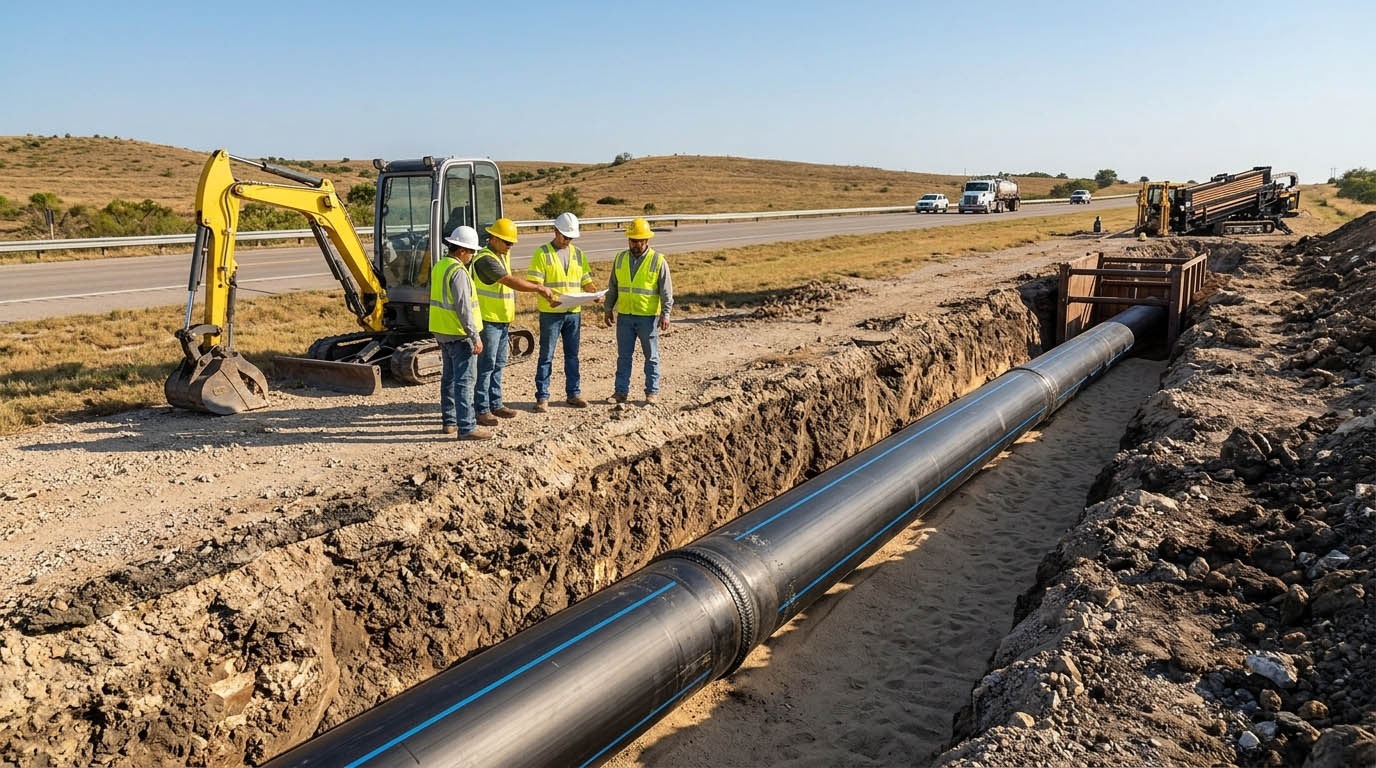
Digging a full trench across a highway, a rail line, or three lanes of city traffic is not always an option. When open cut is off the table, the choice comes down to two trenchless methods, and picking the wrong one costs schedule and money fast.
HDPE pipe is what makes both methods work in the first place. Its fusion joints hold together under pulling loads that would separate mechanically joined pipe, which is why HDD and pipe bursting are both built around it. Here is how Texas crews decide which one fits the job.
Horizontal Directional Drilling Explained
Horizontal directional drilling bores a curved path underground from an entry pit to an exit pit, then pulls a continuous string of fused HDPE pipe back through that bore in one motion. A drill rig steers a cutting head along the planned path, drilling mud flushes the cuttings and stabilizes the hole, and a back-reamer enlarges the bore before the pipe gets pulled through.
The Plastics Pipe Institute’s guidance on horizontal directional drilling notes that HDPE remains the material of choice for HDD work because of its flexibility and fusion joints that hold strength equal to the pipe wall itself. That combination is what lets a single fused string travel hundreds or thousands of feet through a bore without a joint failure along the way.
HDD is the standard choice for road crossings, river crossings, rail crossings, and any urban corridor where cutting the surface is not realistic. It requires DR selection based on pull tension and bore depth, so the pipe going through the drill has to be sized for the job, not just for the service pressure it will carry once it is in the ground. Bore length matters just as much as diameter here, since pulling tension scales directly with how far the string has to travel through the hole.
Pipe Bursting Explained
Pipe bursting replaces an existing pipeline rather than crossing under an obstacle. A bursting head travels through the old pipe, breaking it apart or splitting it outward while pulling a new fused HDPE string in behind it. The method is common for replacing aging cast iron, clay, or old steel water and sewer lines without excavating the entire route.
Because the new pipe follows the exact alignment of the old line, pipe bursting works well in developed areas where the original utility corridor is already established and re-routing is not practical. The upsized HDPE pipe that comes out the other end often has more capacity than the pipe it replaced, which is a common reason municipalities choose bursting during a capacity upgrade rather than a straight repair. It also avoids the permitting and traffic control burden of trenching a new route through an already congested right-of-way.
What Each Method Actually Requires On Site
Both methods depend on getting the pipe spec right before pull day, not adjusting after the fact.
- Bore or host pipe diameter and length, used to calculate pulling tension against the pipe’s safe pull strength
- DR rating selected to resist collapse from external pressure and to survive the pulling load without exceeding allowable stress
- Fusion equipment on site to weld the full string above ground before pullback begins
- Entry and exit pit access sized for the drill rig or bursting equipment being used
- A pull plan that accounts for bends, elevation changes, and soil conditions along the route
Getting any one of these wrong mid-pull is expensive. A pipe that collapses under drilling fluid pressure or fails in tension has to come back out, and that means redoing the bore.
Choosing Between HDD and Pipe Bursting
| Factor | HDD | Pipe Bursting |
|---|---|---|
| Best use case | New alignment under an obstacle | Replacing an existing failed or undersized line |
| Existing pipe on route | Not required | Required as the host pipe |
| Capacity upgrade potential | Sized to design need | Can upsize beyond the original pipe |
| Typical application | Road, river, rail crossings | Aging water or sewer main replacement |
| Route flexibility | Follows a new bore path | Follows the existing utility corridor |
Why HDPE Pipe Is the Only Real Fit for Both Methods
Rigid pipe materials do not tolerate the bending and tensile loading that trenchless installation puts on a pipe string. HDPE handles both because it flexes along the bore path and its PE 4710 resin grade carries enough tensile strength to survive long pulls without stretching past its safe pull limit.
Fusion joining is the other half of the equation. A butt fusion joint on HDPE pipe forms a bond as strong as the pipe wall, which means a fused string can be pulled through a bore hundreds of feet long without a mechanical joint working loose under load. That is not something a bolted or gasketed joint can survive in a trenchless application. It is also why fusion equipment needs to be on site and operating correctly before the first foot of pipe goes into the ground, since a bad fusion weld discovered mid-pull means pulling the whole string back out.
When Neither Trenchless Method Is the Right Call
Trenchless installation is not always the better option just because it avoids surface disruption. Very shallow depths, extremely large diameters, or ground conditions with heavy rock or unpredictable obstructions can make HDD and bursting more expensive and riskier than a straightforward open cut trench.
A short run through open farmland or an undeveloped right-of-way is usually cheaper to trench directly than to bore, since entry and exit pits, drilling mud handling, and bore path engineering all add cost that a simple trench does not require. The decision should follow the jobsite conditions and project length, not a default preference for trenchless methods on every job.
How Coastal Resource Group Supports Trenchless HDPE Projects
Getting the DR rating, PE grade, and fusion plan right before pull day is the difference between a clean installation and a stalled jobsite. Coastal Resource Group stocks the full HDPE DR and PE grade range alongside McElroy fusion machine rentals, so contractors running HDD or pipe bursting jobs can source pipe and fusion equipment from a single Texas supplier rather than coordinating multiple vendors. That matters most on projects tied to Texas pipeline construction work, where schedule delays on trenchless crossings ripple through the rest of the project timeline.
Choosing between HDD and pipe bursting comes down to whether you are crossing an obstacle or replacing what is already in the ground, and the right DR rating follows from that decision, not the other way around. Call 888-841-7954 or contact our team, and we will confirm the right DR rating for your HDD or bursting job.